

What Pikas Can Teach Us About a Warming Alpine World
Before first light, the shoreline of Moraine Lake is quiet. Soon there will be thousands or tourists here to see the sunrise glow of the Valley of the Ten Peaks, reflected in the calm turquoise waters below. It is truly stunning.

But, before you get to the well-known view point, you must head up the Rockpile trail, and this is often my favourite part. This is where I stop to listen to the landscape and hope to find a pika.
Once you hear it, you know!
MEEP

Their call echoes off the rocks, small but insistent. I scan the slope, eyes moving slowly over the broken limestone. Just waiting for the slightest twitch of fur between stones. Another call. Then a flicker of movement. A rounded shape rises onto a rock, upright and alert, issuing a warning to anything within earshot.
The American pika weighs barely 150 grams, but on these slopes it carries itself like a sentry.
I have spent several summer mornings here, listening for that first call. Over time, the routine has become familiar: hear the meep, freeze, scan, watch. And once you begin watching closely, you realize that summer, for a pika, is not just a season of abundance. It is a season of urgency.
Life Between the Rocks
Pikas are small alpine mammals more closely related to rabbits than to rodents. In Banff National Park they inhabit talus slopes. These seemingly inhospitable piles of broken rock that collect beneath cliffs and ridgelines, are actually a haven for pikas. What looks barren from a distance is a labyrinth of tunnels, cool chambers, and hidden runways that they use all year round.
That’s right, they do not hibernate.
Instead, they survive winter by harvesting vegetation all summer long, creating carefully dried “haypiles” stored beneath the rocks. Each mouthful of fireweed, grass, or alpine flower is clipped, carried, and cached to sustain them through months of snow cover.

One of the most common scenes I photograph is a pika mid-stride, cheeks bulging with a bouquet of green. The image is charming and almost comical but it represents something serious. That bundle of plants is insulation against starvation. It is a wager on how long winter will last.
Even grooming, another behaviour I’ve documented in the early light, is practical. Clean, well-maintained fur traps heat efficiently. In an environment where temperatures swing dramatically and shelter is limited to what stone can provide, maintenance matters.
Summer is short in the alpine. Every hour is accounted for.
Heat, Snow, and the Fine Margins of Survival
Pikas are climate-sensitive. They have a low tolerance for heat and can suffer from thermal stress if exposed to high temperatures for extended periods. But focusing only on summer heat oversimplifies their challenge.
Winter is just as critical.
Snowpack acts as an insulating blanket, stabilizing temperatures within the talus and protecting pikas from extreme cold snaps. When snow arrives late, melts early, or forms ice crusts after freeze–thaw cycles, that insulation can be compromised. A species that depends on steady conditions beneath the rocks becomes vulnerable to variability.
In parts of the western United States, particularly at lower elevations in the Great Basin, some pika populations have declined or disappeared. The Canadian Rockies tell a more nuanced story. So far, pika populations in Banff and Jasper National Parks appear relatively stable, buffered in part by higher elevations and complex terrain.
Watching the Small Things
Long-term ecological monitoring looks like clipboards, GPS points, repeated visits, and careful listening. Parks Canada and collaborating researchers have monitored pikas by surveying talus slopes, documenting haypiles, and recording vocalizations to estimate occupancy and distribution over time. Year after year, the same sites are revisited to understand trends.
The goal is to determine whether pika populations are holding steady, shifting upslope, fragmenting, or declining.
These efforts are part of a broader long-term ecological monitoring program across the mountain national parks. Vegetation plots track changes in alpine plant communities. Snowpack and climate stations record shifts in temperature and precipitation. Wildlife corridors are studied to understand connectivity across highways and valleys.
The pika, small as it is, fits into a much larger picture.
Because alpine ecosystems function as water towers for downstream communities, changes at elevation ripple outward. Snow regimes influence river flow. Plant communities shape soil stability. The health of talus slopes reflects microclimates that can buffer (or amplify) the impacts of warming.

Monitoring pikas is not just about pikas. It is about paying attention to the integrity of an entire high-elevation system.
Photographing pika responsibly
When I first began photographing them, I was drawn by their charisma. The upright posture. The improbable bouquet of plants clutched in their mouths. The quick grooming motions between foraging trips.
Photographing pikas is as much about patience and respect as it is about timing. Because they are small and quick, it can be tempting to move closer or reposition frequently, but this can cause unnecessary stress.
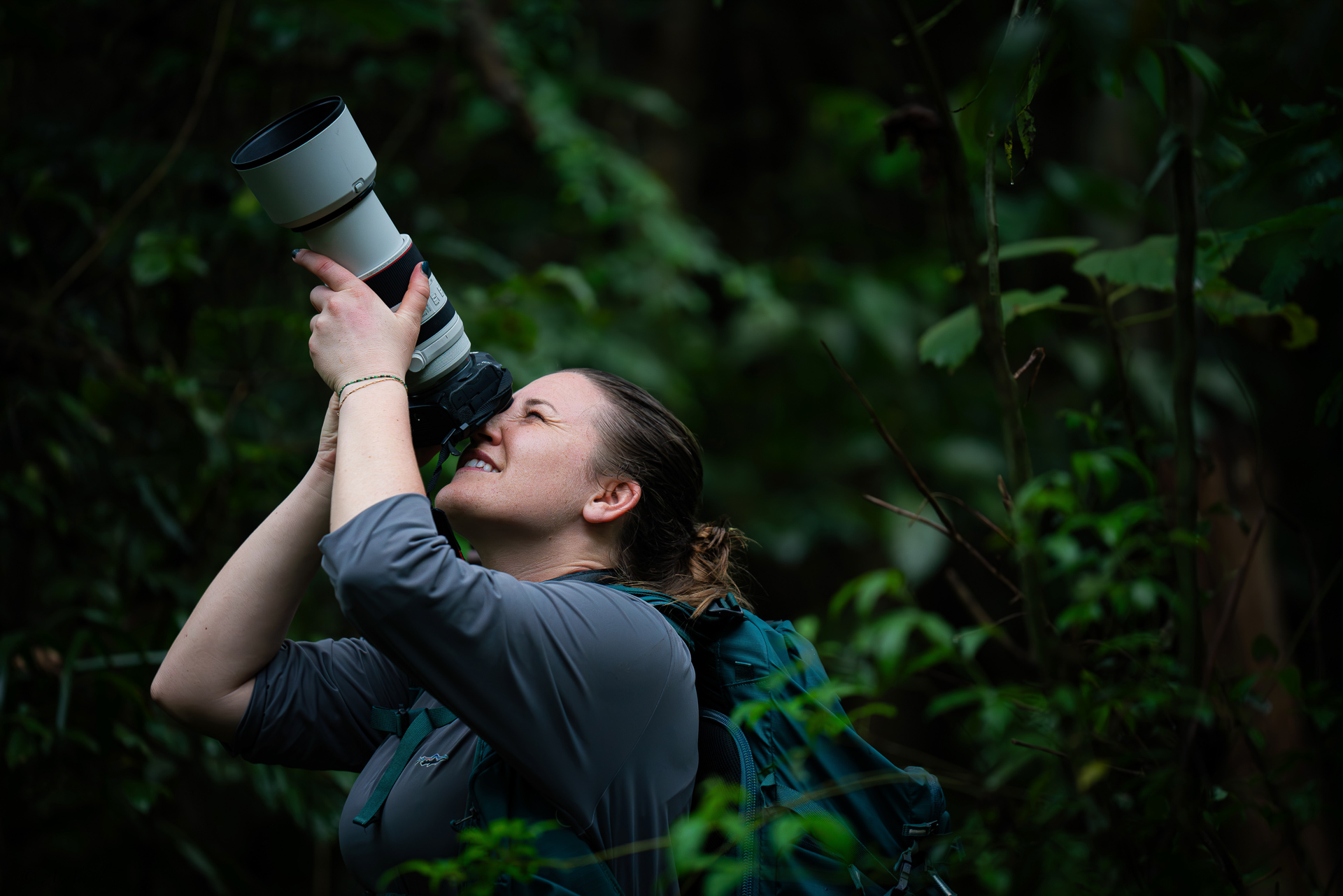
Use a longer lens rather than approaching too closely. If a pika begins giving repeated alarm calls or disappears entirely, you are likely too close. Sudden movements can send them back into hiding for extended periods, so move slowly and deliberately.
The goal is to observe and document, not interfere.
Over time, the images have come to mean something more. They are records of behaviour tied to season, temperature, and snow. They are visual notes in an ongoing story that scientists are also telling through data sheets and repeated surveys.
The pika does not know it is considered an indicator species. It does not know it symbolizes alpine vulnerability in a warming world. It only knows that summer is brief, and the work must be done.

As conservation photographers, our role is not only to document beauty. It is to connect behaviour to meaning, to show how the smallest resident of a vast mountain landscape can embody both resilience and risk.
About the Author

Lianne is a science communicator, expedition leader, and conservation photographer with a background in zoology and a deep passion for connecting people to the natural world through storytelling. Her work spans some of the planet’s most remote and spectacular regions—from the fjords of Greenland and volcanoes of Iceland to the wild coasts of British Columbia, the tundra of Northern Canada, and the icy expanse of Antarctica. As a guide and educator, she leads conservation-focused photography expeditions designed to foster a sense of awe, understanding, and stewardship.
Lianne’s interests lie in human-wildlife coexistence and the role ethical wildlife tourism and visual storytelling can play in conservation. She believes photography is not just about capturing beauty, but about deepening our relationship with the world around us. A single image has the power to bring people into a moment—to feel the chill of polar air, the scent of a mossy forest, or the quiet intimacy of observing wildlife in its element.
Now based in British Columbia, Lianne continues to use photography as both a mindful practice and a powerful conservation tool. Through her work, she hopes to inspire curiosity, encourage protection of wild spaces, and support meaningful connections between people and planet.


Comments